Google Nest Learning Thermostat – 3rd Gen – Programmable Smart Thermostat for Home – Compatible with Alexa (Stainless Steel) (ASIN B0DZDB98JG)
Best Nest Thermostat Buying Guide — Black Friday Deals 2026
Shopping for a Nest Thermostat during Black Friday starts with a more useful question than “Which offer is lowest?” Consider how you want schedules handled, whether room sensing matters, and what you know about your heating and cooling setup. The three options here offer different combinations: app-based scheduling, learning features, and an included temperature sensor. Their provided details can help narrow the choice, but they do not establish whether a particular thermostat fits every home. Compare the exact model and package in any Black Friday listing, then check the stated compatibility against your own system before deciding.
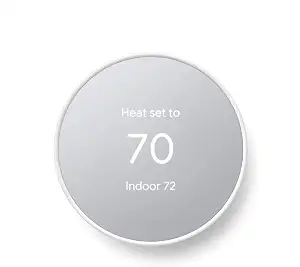
Best Budget is an editorial label for the Google Nest Thermostat – Snow because its listed details center on app scheduling and remote adjustment without describing the learning features or included room sensor found in the other options. That is not a claim about its sale price or a promise that it will be the least expensive choice in a Black Friday listing. Instead, it points to a shopper who wants to program a schedule in the Google Home app on an Android phone or iPhone and change the temperature remotely using a phone, laptop, or tablet. If those are the controls you expect to use, the stated feature set gives you a clear basis for comparison.
The scheduling approach here is an energy-efficient schedule that you program in the app. Think about whether you prefer to enter the temperatures and timing yourself, and whether you are comfortable making adjustments when your routine changes. The facts establish app-based scheduling and remote control; they do not say that this model learns your preferences. Avoid treating that as a shortcoming if you want direct control over the schedule, but compare it carefully if automatic learning is a priority. Its Wi-Fi connectivity is also listed, so consider that alongside your intended app use when reviewing the product information.
This Nest Thermostat is designed to work without a C wire in most homes, but some systems—including heating-only, cooling-only, zone-controlled, and heat-pump systems—need a C wire or another compatible power accessory. Check your system type and wiring rather than relying on the general “most homes” qualification. The thermostat is compatible with Google Assistant and all Matter-certified voice assistants, while voice control requires a compatible smart device. That distinction is useful if hands-free adjustment matters: assistant compatibility does not itself provide the smart device needed to issue voice commands. During Black Friday, compare the exact Snow model and the offer details, and do not assume a lower headline price means the included package or compatibility is right for your home. The Best Budget designation describes its straightforward stated feature mix, not a price finding.
Key specs
Scheduling
easily program an energy efficient schedule in the Google home app on your Android or iPhone
Remote control
Remote control lets family members change the thermostat temperature from anywhere on a phone, laptop, or tablet[1]
C-wire compatibility
The Nest Thermostat is designed to work without a C wire in most homes, but for some systems, including heating only, cooling only, zone controlled, and heat pump systems, you’ll need a C wire or other compatible power accessory.
Voice assistant compatibility
Compatible with Google Assistant and all Matter-certified voice assistants.
Voice control requirement
Voice control requires a compatible smart device.
Connectivity
Wi-Fi
Google Nest Learning Thermostat (4th gen) + Nest Temperature Sensor (2nd gen) – Obsidian
Google Nest Learning Thermostat (4th gen) + Nest Temperature Sensor (2nd gen) – Obsidian (ASIN B0D5BBYRJM)
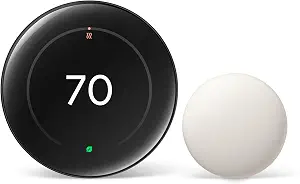
Best Overall is an editorial fit for shoppers who want a learning thermostat and a room sensor in the same package. The Google Nest Learning Thermostat (4th gen) + Nest Temperature Sensor (2nd gen) – Obsidian can be adjusted on a phone from anywhere, or by voice with an Alexa, Siri, or Google Assistant smart speaker. It is also Matter compatible for smart home integration. Those details make it a strong starting point if your priorities include remote adjustment, voice options, and connecting the thermostat with a Matter-compatible setup. They do not mean every preferred control method is guaranteed to work without the required compatible devices; check your own setup before relying on voice control.
The included Nest Temperature Sensor (2nd gen) is a meaningful distinction for households thinking about temperatures in more than one room. You can put a sensor in a room and use the Google Home app to set the temperature it should reach at a particular time of day. That can suit someone who wants to prioritize a room on a schedule rather than make the thermostat decision based only on the included thermostat itself. Consider where you would place the sensor and when you would want its scheduled target to apply. The supplied details establish the sensor’s role in room-temperature scheduling, but do not specify how many rooms it can serve at once or guarantee a particular comfort result.
Compatibility is described as covering most 24V systems, including gas, electric, oil, forced air, heat pump, and radiant; no C wire is required for installation in most homes. “Most” matters: treat that as a reason to investigate, not a substitute for checking your system. The thermostat also uses the temperature outside to help find an energy-saving temperature while you are away, then returns to a comfortable temperature within an hour of your return. Black Friday shoppers comparing this bundle should confirm that the listing is this 4th-gen Obsidian package with the 2nd-gen sensor, rather than assuming another Nest listing includes the same accessory. The Best Overall label reflects the breadth of the provided features, not a tested or market-wide ranking.
Key specs
System compatibility
works with most 24V systems, including gas, electric, oil, forced air, heat pump, and radiant, and no C wire is required for installation in most homes
App and voice control
Adjust on your phone from anywhere[1] or by using your voice with Alexa, Siri, or Google Assistant smart speaker[3]
Smart home support
it’s easy to install yourself and it’s Matter compatible for simple integration into your smart home[5]
Included sensor
it comes with the Nest Temperature Sensor (2nd gen)
Room temperature scheduling
put a sensor in any room and use the Google Home app to set the temp it should reach at a certain time of day
Away temperature adjustment
It uses the temperature outside to help find an energy-saving temperature when you’re away and returns to a comfortable temperature within an hour of your return[1]
Google Nest Learning Thermostat – 3rd Gen – Programmable Smart Thermostat for Home – Compatible with Alexa (Stainless Steel)
Google Nest Learning Thermostat – 3rd Gen – Programmable Smart Thermostat for Home – Compatible with Alexa (Stainless Steel) (ASIN B0DZDB98JG)
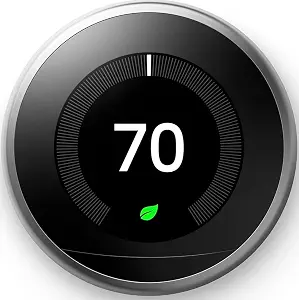
Best for Learning a Schedule is the fitting editorial label for the Google Nest Learning Thermostat – 3rd Gen – Programmable Smart Thermostat for Home – Compatible with Alexa (Stainless Steel). The provided feature that sets its role is direct: it learns your schedule and the temperatures you like, then programs itself. That may appeal if you would rather not create the full schedule manually. It is still worth thinking about how much control you want to exercise yourself. The facts do not explain the learning process or promise that its schedule will always match a household’s preferences, so regard learning as a listed capability rather than a guaranteed outcome.
Home/Away Assist automatically adjusts the thermostat to an Eco Temperature after you leave. Remote control lets you change the temperature from anywhere on a phone, laptop, or tablet. Together, those features may be relevant to someone whose plans vary and who wants a way to adjust settings while away. Energy History lets you check on your phone how much energy you used and why, while HVAC monitoring sends an alert if something does not seem right with the heating or cooling system. These tools provide different kinds of information and adjustments; they should not be read as a promise of a particular energy result or as a diagnosis of a system issue.
For room-specific temperature information, this model works with the Nest Temperature Sensor, which is sold separately. That creates a different package consideration from the 4th-gen option here, which includes a 2nd-gen sensor. If sensing is important, compare the exact Black Friday listing and account for the stated separate-sensor status rather than judging the thermostat name alone. The facts provided for this model do not specify system compatibility or C-wire requirements, so verify those details for the exact product before choosing it. The Best for Learning a Schedule label rests on its listed self-programming feature; it does not claim that it is superior for every household or that a Black Friday offer includes an accessory not stated in the listing.
Key specs
Scheduling
learns your schedule and the temperatures you like and programs itself
Home/Away Assist
automatically adjusts itself to an Eco Temperature after you leave
Remote control
remote control lets you change the temperature from anywhere on your phone, laptop, or tablet[1]
Energy history
With Energy History, just check your phone to see how much energy you used and why
HVAC monitoring
looks out for your heating and cooling systems; sends an alert if something doesn’t seem right
Temperature sensor compatibility
works with the Nest Temperature Sensor (sold separately)
Make wiring and system information part of the shortlist
Before comparing app controls or learning features, write down what you know about your heating and cooling system. The supplied compatibility information is not identical across these products, so avoid assuming that one model’s wiring statement applies to another. The 4th-gen Learning Thermostat is described as working with most 24V systems, including gas, electric, oil, forced air, heat pump, and radiant, with no C wire required in most homes. The Snow Nest Thermostat is also designed to work without a C wire in most homes, but its details name several system types that may need a C wire or compatible power accessory. For the 3rd-gen Learning Thermostat, the supplied facts do not specify wiring or system compatibility.
These qualifications make the exact product page and your own system details important parts of a Black Friday decision. If you are unsure which system you have or what wiring is present, pause before treating a general compatibility statement as confirmation. Check the exact model’s requirements and consider getting appropriate installation guidance. A thermostat that appears to match your preferred feature list is not automatically the right fit if its installation requirements have not been checked. Black Friday urgency should not replace this step: the useful comparison is between offers you can verify, not between assumptions about compatibility.
Pick a schedule approach that suits your habits
The products present different approaches to temperature schedules. With the Snow model, you program an energy-efficient schedule in the Google Home app. The 3rd-gen Learning Thermostat learns your schedule and the temperatures you like, then programs itself. The 4th-gen Learning Thermostat’s provided facts describe temperature scheduling for its included sensor: use the Google Home app to set the temperature a room should reach at a certain time of day. These descriptions are not interchangeable, so consider what you actually want to manage. If you like setting the plan yourself, app programming is a concrete feature to compare; if you want a thermostat that learns and programs itself, the 3rd-gen listing states that capability.
Ask how often your household’s routine changes and whether you want to intervene when it does. The supplied facts do not establish which schedule will suit an individual home best, or how any model will respond to every change. Black Friday can make feature names compete for attention, but the relevant detail is the scheduling behavior stated for the exact model. A good shortlist connects that behavior to your routine instead of assuming that “learning” or “programmable” means the same experience across products.
Decide whether room sensing is central to your plan
Only one of these listed packages explicitly includes a temperature sensor: the 4th-gen Learning Thermostat bundle comes with the Nest Temperature Sensor (2nd gen). Its facts say you can place a sensor in a room and use the Google Home app to set the temperature it should reach at a certain time of day. That can make the bundle relevant if you want a scheduled target for a room beyond simply considering the thermostat’s own controls. The 3rd-gen Learning Thermostat works with the Nest Temperature Sensor, but the sensor is sold separately. The Snow model’s supplied facts do not describe a temperature sensor, which is not proof that a particular listing has no other package details; inspect the exact listing.
Consider whether you have a room that you want to prioritize and whether you would actually use a sensor schedule. If you would, compare included versus separately sold accessories carefully during Black Friday. If not, an included sensor may not be a deciding reason to choose a bundle. Do not assume that a sensor controls every room or guarantees a particular temperature throughout the home: the provided information describes placing it in a room and setting a scheduled temperature target, not broader performance claims.
Separate app access, voice commands, and smart home links
Remote control and voice control are distinct considerations. The Snow thermostat lets family members change the temperature remotely from a phone, laptop, or tablet, and it is compatible with Google Assistant and all Matter-certified voice assistants. Voice control requires a compatible smart device. The 4th-gen Learning Thermostat can be adjusted from a phone or by voice with an Alexa, Siri, or Google Assistant smart speaker, and it is Matter compatible. The 3rd-gen model’s facts specify remote changes from a phone, laptop, or tablet. They do not provide the same voice or Matter details, so check the exact listing rather than filling in missing information.
Think through the devices and services you already intend to use, then compare the stated compatibility with those plans. A voice assistant being named as compatible does not mean that every household already has the device needed for voice control. Similarly, remote phone access is not the same feature as voice commands or Matter integration. Black Friday descriptions can compress these terms, so separate them when evaluating a product: identify the control method you value and the compatible device, if any, that the listing says is needed.
Read Black Friday offers as exact model-and-package choices
A Black Friday headline can draw attention to a product family while leaving the important distinction in the model name or package. Compare the Snow Nest Thermostat with the 4th-gen Learning Thermostat bundle and the 3rd-gen Learning Thermostat as separate options. The 4th-gen package named here is Obsidian and includes the Nest Temperature Sensor (2nd gen); the 3rd-gen model is Stainless Steel and its compatible sensor is sold separately. The Snow product is identified as Snow. These names and accessory details help you confirm which version a listing describes before judging whether its features meet your needs.
Do not infer a promotion, discount, stock status, or package contents from the season or from another listing. Check the exact offer’s model identity, included items, and stated compatibility. Then compare those details with your priorities: self-programmed scheduling, learning a schedule, remote or voice control, an included sensor, or the listed energy and HVAC information features. The Best Overall and Best Budget labels here are editorial choices among these three products, not evidence about a particular Black Friday offer. A careful match between the offer and your intended use is more useful than a headline that does not identify the variant clearly.
Make your Black Friday choice
The right Nest Thermostat choice depends on which details matter in your home, not on a seasonal label alone. Choose the Snow model if app-programmed scheduling and remote control fit your priorities, the 3rd-gen Learning Thermostat if its stated schedule-learning feature appeals, or the 4th-gen bundle if its included sensor and room-temperature scheduling are useful to you. Check system compatibility and the exact package before buying. During Black Friday, compare the specific model and stated offer without assuming a discount or accessory that is not shown. That keeps the decision grounded in features you can verify.