ASUS Dual GeForce RTX 5070 12 GB GDDR7 OC Edition Buying Guide — Black Friday Deals 2026
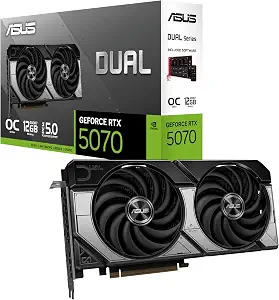
The ASUS Dual GeForce RTX 5070 12 GB GDDR7 OC Edition is a specific option to consider if you are shopping for an asus rtx 5070 and want to weigh its listed memory, architecture, outputs, and fan features together. For Black Friday, begin with your own priorities rather than the event label: decide which named features matter to your setup, then check that the offer is for this exact model. The supplied details describe capabilities and design points, not a promised result in every game or system.
This card pairs 12 GB GDDR7 memory with NVIDIA Blackwell architecture and DLSS 4. Its stated clock speed is up to 2572MHz in OC Mode, so treat that figure as a mode-specific detail rather than a general guarantee about how it will operate in every situation. The combination gives shoppers several concrete items to compare, but the listing alone does not establish how a particular game or workload will perform.
Its HDMI 2.1b and DisplayPort 2.1b outputs, plus an Axial fan design and 0dB technology, add practical questions to your shortlist: which connections do you plan to use, and how relevant is the stated light-game noise feature to your routine? Best for shoppers who prioritize the listed 0dB technology for light games. That label reflects a provided feature, not a measured advantage. During Black Friday, use these details to judge the exact variant rather than assuming every RTX 5070 listing describes the same card.
Make the listing the first Black Friday checkpoint
Before comparing an offer, confirm that its product name and variant match ASUS Dual GeForce RTX 5070 12 GB GDDR7 OC Edition. A Black Friday event can make several listings feel interchangeable, but this buying decision depends on the details attached to the exact item. Check that the offer identifies the OC Edition and the same memory configuration, rather than relying on a broad RTX 5070 search result or a headline alone.
Then review the offer information shown at checkout, including the seller, delivery details, and any return terms presented there. These are things to verify, not claims about what a particular listing will provide. If the displayed offer changes, pause and recheck the model before proceeding. This straightforward comparison keeps the Black Friday decision anchored to what is actually being offered, without assuming a discount, availability, or policy.
Put the memory figure beside your real workload
The listed memory is 12 GB GDDR7. Use that as a concrete specification to compare with the requirements of the games or applications you intend to run; do not treat the number by itself as a guarantee of suitability. If a particular title or task publishes memory guidance, compare that guidance with the card’s stated capacity and consider the rest of your system too. The product details here do not provide workload results or broader system requirements.
For a Black Friday shortlist, write down the work you expect the card to handle and the information you still need before deciding. This keeps the memory detail useful without stretching it into an unsupported performance prediction. If the listing does not answer a question important to your planned use, seek that detail from the relevant product or software documentation before purchase.
Keep Blackwell and DLSS 4 in the feature column
The product is described as powered by NVIDIA Blackwell architecture and DLSS 4. Those are worth noting if you are comparing named technologies across your shortlist, but the supplied facts do not quantify their effect for a particular game, visual setting, or workload. Avoid turning the presence of these names into an assumption about frame rates or image quality; check the software information for the titles you care about if those outcomes shape your choice.
This is especially useful during Black Friday, when a short product summary may encourage a quick comparison based on labels alone. Separate what is explicitly listed from the questions you still need answered. You can then decide whether these technologies matter to your own plans, rather than treating them as a universal reason to choose this model.
Read the OC clock as a mode-specific detail
The stated clock speed is up to 2572MHz in OC Mode. Preserve both qualifications when using it in a comparison: it is an “up to” figure, and it is tied to OC Mode. It does not tell you what clock will apply in every operating condition, nor does it establish a direct performance result against another card. Keep the number on your checklist as a specification, not as a substitute for the use-case information you need.
If the figure is important to your Black Friday decision, check that another offer you are comparing describes its clock in a directly comparable way. Different wording or modes can make headline figures difficult to interpret side by side. The useful next step is to compare like with like, while keeping your decision grounded in the exact variant and the requirements of your intended tasks.
Plan around the display connections you intend to use
The listed outputs are HDMI 2.1b and DisplayPort 2.1b. Before buying, note which connection your intended display uses and confirm that the cable and connection plan you need are supported by the equipment involved. The product details identify the output names, but do not specify a particular display setup or promise that every configuration will work without checking the other components.
For Black Friday, this is a practical way to narrow the decision before focusing on the offer itself. Write down the displays you expect to connect, then compare their connection requirements with the card’s listed outputs and the documentation for your other equipment. If you are choosing between listings, verify the output information for each exact variant instead of assuming it is identical.
Set expectations for the fan features
ASUS describes an Axial fan design with a smaller fan socket that facilitates longer blades and a barrier ring that increases downward air pressure. The product details also state that 0dB technology allows light games to be enjoyed in relative silence. Keep that qualification intact: it refers to light games and relative silence, not every workload or a specific noise level. The description offers design context, but it is not a measured comparison.
Consider how relevant that stated light-game use is to your routine. If it matters, compare the wording on the exact Black Friday listing and avoid assuming the same claim applies under every condition. If cooling behavior or noise is central to your choice, look for information that addresses your intended use specifically; the listed fan details alone do not answer every operating question.
Key specs
Memory
12 GB GDDR7
Architecture and upscaling
Powered by NVIDIA Blackwell architecture and DLSS 4
OC clock
clock speeds up to 2572MHz in OC Mode
Display outputs
HDMI 2.1b, DisplayPort 2.1b
Fan design
Axial fan design features a smaller fan socket that facilitates longer blades, and a barrier ring that increases downward air pressure
Fan technology
The 0dB technology allows you to enjoy light games in relative silence
Make your Black Friday choice
A careful Black Friday purchase starts with the exact ASUS variant, then moves through the details that affect your decision: memory against your intended workload, named technologies, the OC Mode clock qualification, display connections, and the limited scope of the fan claims. Verify the live offer and its terms before checkout, and compare like-for-like listings rather than relying on an event label or a headline figure. That approach keeps the asus rtx 5070 search focused on the features this card actually lists and the questions that matter to you.