Best Good Laptop Buying Guide — Black Friday Deals 2026
A good laptop is one that fits the work you actually plan to do, rather than one chosen just because a Black Friday banner looks compelling. This shortlist covers three distinct priorities: a 14-inch Windows-style student configuration with 16GB RAM, a Chrome OS option with a stated battery-life claim, and a Lenovo V15 with a broad set of listed connections. Their screens, processors, memory, storage and operating systems differ, so compare them against your own software needs and routine. Black Friday offers can change the value calculation, but the product details still deserve a careful look: confirm that the exact model and configuration in the offer are the ones you intend to buy.
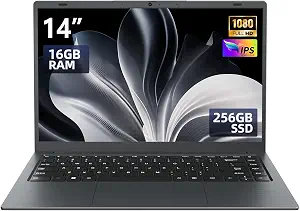
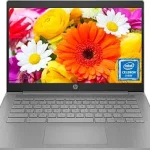
Best Overall is the editorial label for this option in the guide, based on the combination of features supplied for it—not on testing or a market-wide ranking. Its 16GB RAM and 256GB SSD are paired with a Pentium 6500Y processor (7W), giving shoppers a clear set of core specifications to compare with their intended school or everyday tasks. Before a Black Friday purchase, think through the applications you expect to use and whether the listed processor and storage arrangement suit those requirements; the specifications alone do not establish performance for every program.
The screen is a 14.0″ IPS FHD (1920×1080) display. That gives you a specific size, panel type and resolution to weigh against your preference for a compact work area or a larger screen. The product name also identifies a webcam cover, a detail worth considering if a physical camera-cover feature is part of your checklist. Avoid assuming that a screen description establishes brightness or other qualities that are not listed here.
Its 5000mAh battery (7.4V) is a capacity figure, not a stated runtime, so it cannot tell you how long the laptop will last between charges. The listed connections include two USB 3.2 Gen1 ports, which may matter if those match the accessories you expect to connect. For Black Friday, compare the exact configuration and its listing details rather than treating the Best Overall label as proof of a discount or measured superiority. This is a reasonable shortlist candidate when its memory, SSD, screen and stated port details align with your priorities.
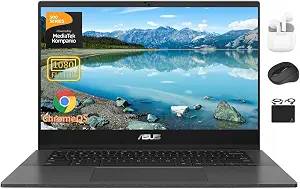
ASUS Chromebook Laptop Student Business 2024 (ASIN B0DFDWN8RT)
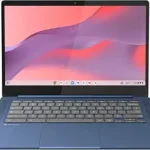
Best Budget is the guide’s editorial label for this Chromebook, not a statement about its current price or a guarantee that it is the least expensive offer. Its Chrome OS operating system makes the choice especially relevant to shoppers who already know that this is the environment they want. The listed hardware is an 8-Core MediaTek Kompanio 520 processor, 4GB RAM and 128GB (64GB eMMC+64GB Card) storage. Consider your usual applications and file habits before deciding whether that combination is a suitable match; the listing does not establish how it will handle every workload.
The display is a 14″ FHD Anti-Glare Display with a resolution of 1920 x 1080 pixels. Those details help define the screen for reading, writing or viewing material, while leaving qualities such as brightness unspecified. For students or other shoppers planning a portable routine, the stated battery claim is up to 15-hour battery life. Keep the phrase “up to” in view: it is not a promise that every person or task will reach that duration.
A privacy shutter is integrated into the webcam, and wireless connectivity is listed as a Wi-Fi 6 and Bluetooth 5.3 combo. These are useful checklist items if camera privacy or those wireless standards matter to your setup, but they do not establish the behavior of devices or networks you might pair with it. During Black Friday, compare the precise Chromebook configuration and current offer terms. This pick makes most sense when Chrome OS, the stated screen and battery claim, and the listed memory and storage fit your plans—not simply because the guide calls it Best Budget.
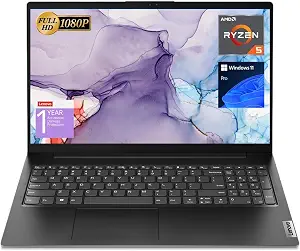
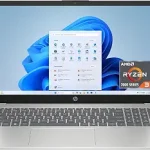
Best for Port Variety is this guide’s label for the Lenovo V15, chosen because its supplied connectivity details name several different connection types. The list includes 1 x USB 3.0 Type-A, 1 x USB 2.0 Type-A, 1 x USB Type-C, 1 x HDMI and 1 x RJ45. If you regularly plan around particular accessories or wired connections, compare those exact ports with the equipment and setup you intend to use. The label is an editorial way to surface that feature, not a claim that every port will suit every shopper.
The laptop has a 15.6″ diagonal, FHD (1920 x 1080) display. Its listed processor is an AMD Ryzen 5 5500U Processor (6 Cores, 12 Threads, 8MB L3 Cache, Clock Speed:2.1GHz, up to 4.0GHz Turbo), alongside 16GB RAM and a 512GB PCIe NVMe M.2 Solid State Drive. These details give you concrete configuration points to compare with your planned work, software requirements and file needs. They do not, by themselves, guarantee a particular experience across applications.
Windows 11 Pro is the listed operating system, and a numeric keyboard is also specified. Consider whether that software environment and keyboard detail fit the way you expect to work. No battery-life figure is supplied here, so avoid comparing runtime based on assumptions. For Black Friday, verify that the selected offer is for this configuration, then weigh its screen, processor, memory, storage and connections against the tasks you named. The Best for Port Variety label highlights the provided port list; your own device requirements should decide whether that list is useful to you.
Key specs
Display
15.6″ diagonal, FHD (1920 x 1080)
Processor
AMD Ryzen 5 5500U Processor (6 Cores, 12 Threads, 8MB L3 Cache, Clock Speed:2.1GHz, up to 4.0GHz Turbo)
Memory
16GB RAM
Storage
512GB PCIe NVMe M.2 Solid State Drive
Operating system
Windows 11 Pro
Connectivity
1 x USB 3.0 Type-A, 1 x USB 2.0 Type-A, 1 x USB Type-C, 1 x HDMI, 1 x RJ45
Keyboard
Numeric Keyboard
Let your routine set the shortlist
Begin by writing down the work the laptop must support: for example, preparing documents, joining online classes, organizing files or using particular applications. Treat these as questions to answer, not as proof that any one model will suit them. Then identify requirements that are non-negotiable, such as a specific operating system or connection type. This step can prevent a Black Friday offer from distracting you from a configuration that does not match your actual plans.
The three options point toward different decision paths. One pairs a Pentium 6500Y processor (7W) with 16GB RAM and a 256GB SSD; another runs Chrome OS and lists 4GB RAM with 128GB (64GB eMMC+64GB Card) storage; the Lenovo V15 lists Windows 11 Pro, 16GB RAM and a 512GB PCIe NVMe M.2 Solid State Drive. Those facts make comparison possible, but they do not predict performance for every application. Check any software requirements you already know, and use the manufacturer’s or seller’s listing for details not included in this guide. The best starting point is your task list, not a generic idea of what a laptop should do.
Choose the screen that fits your working space
Screen descriptions can narrow a shortlist without settling the whole decision. The student laptop lists a 14.0″ IPS FHD (1920×1080) screen; the Chromebook lists a 14″ FHD Anti-Glare Display at 1920 x 1080 pixels; and the Lenovo V15 lists a 15.6″ diagonal, FHD (1920 x 1080) display. Use the stated dimensions and resolution to think about your preferred workspace and portability, rather than assuming that one description guarantees a particular viewing experience.
If you often arrange several windows, consider how much screen area you want in your usual setting. If your work involves long reading or writing sessions, check whether the listed display description answers your needs, and look for any additional details that matter to you in the exact listing. The Chromebook’s anti-glare wording is explicitly provided; that does not supply other screen qualities. Black Friday can make it tempting to decide quickly, but screen preferences are personal. Compare the exact model and its display details against where and how you plan to use it before letting an offer determine the choice.
Treat memory and storage as separate questions
Memory and storage serve different purposes in a buying decision, so assess each against your routine. The provided configurations list 16GB RAM with a 256GB SSD for the student model, 4GB RAM with 128GB (64GB eMMC+64GB Card) for the Chromebook, and 16GB RAM with a 512GB PCIe NVMe M.2 Solid State Drive for the Lenovo V15. These are specifications to compare, not a guarantee about how many files or applications you will comfortably manage.
Think about the programs you expect to keep open and the kinds of files you plan to keep on the laptop. If your needs are uncertain, check the requirements of your important software and estimate your own storage habits before choosing. Do not read a larger listed storage capacity as proof that the laptop is automatically the right fit, or infer that an unlisted expansion option exists. During Black Friday, compare the storage and memory on the exact offer with the configuration you researched. That habit helps separate a genuinely relevant specification from a headline that merely sounds attractive.
Check the operating system and connections together
The Chromebook lists Chrome OS, while the Lenovo V15 lists Windows 11 Pro. The student model’s supplied details do not identify an operating system, so confirm that point in its exact listing if it affects your decision. Before buying, check the operating system requirements for applications and services you rely on rather than assuming that different systems will behave identically. This is especially important if school, work or personal tasks specify a particular environment.
Next, list the connections you expect to need. The Lenovo details name USB 3.0 Type-A, USB 2.0 Type-A, USB Type-C, HDMI and RJ45 ports; the student model lists two USB 3.2 Gen1 ports. The Chromebook listing supplies Wi-Fi 6 and Bluetooth 5.3 combo details. Match those facts against your own equipment and network needs, and verify anything not stated here in the product listing. Black Friday should be a reason to compare configurations carefully, not to assume an accessory will connect or that an unlisted port is present.
Read battery and privacy claims in context
Battery information is not presented in the same way across these options. The Chromebook listing says up to 15-hour battery life, while the student laptop specifies a 5000mAh battery (7.4V); the Lenovo details provided here do not include a battery figure. Capacity and runtime are different kinds of information, so do not convert the student model’s capacity into hours or treat the Chromebook’s qualified claim as a guaranteed result for every routine. If time away from an outlet matters, seek details relevant to your expected use.
Privacy details also deserve precise reading. The Chromebook lists an integrated webcam privacy shutter, and the student laptop’s product name identifies a webcam cover. Those are the specific camera-related details supplied for those products; avoid inferring other privacy controls from them. Before a Black Friday checkout, confirm that the offer matches the intended model and review the listing for any requirements that matter but are not covered here. A careful comparison keeps qualified claims in view and helps you make a choice based on stated features instead of assumptions.
Make your Black Friday choice
A good laptop choice comes from matching a real routine to a clearly identified configuration. Use the Chromebook’s Chrome OS, stated battery-life claim and privacy shutter as points to evaluate; consider the student model’s RAM, SSD, display and listed battery capacity; and weigh the Lenovo V15’s Windows 11 Pro configuration and named connections against your needs. The labels in this guide are editorial signposts, not test results or market-wide awards. When Black Friday offers appear, check the exact model and configuration before comparing the deal. That way, the offer supports your decision instead of making it for you.