 Check Price on Amazon
MSI GeForce RTX 5070 Ti 16G Shadow 3X OC Gaming Graphics Card Buying Guide — Black Friday Deals 2026
A Black Friday graphics-card shortlist is most useful when it starts with the parts of the listing that affect your own setup, rather than an assumed discount or performance promise. The MSI GeForce RTX 5070 Ti 16G Shadow 3X OC combines a stated 16GB GDDR7 memory configuration, a Boost clock of 2482 MHz, PCIe 5, DisplayPort and HDMI outputs, and a minimum power-supply recommendation. Those details give you concrete checkpoints for deciding whether this exact card belongs on your list. Before comparing a Black Friday offer, consider the connection, screens and power supply in the system you plan to use.
Best for shoppers prioritizing a clearly specified memory configuration: this card lists 16GB GDDR7 at 28Gbps on a 256-bit interface. That is a useful starting point for comparing graphics-card listings, but it should not be treated as a promise about frame rates or how a particular game will run. The listed Boost clock is 2482 MHz; keep it as a separate specification rather than assuming it predicts results in every system or workload. During Black Friday shopping, compare these exact details with the same model and variant in any offer you consider.
The product listing also identifies PCIe 5, three fans, DisplayPort and HDMI outputs, and maximum display resolution of 4K UHD (3840×2160). It specifies a power supply with min. 750 W. Taken together, these are practical items to check against your planned system and displays, not a complete assessment of fit or performance. The card is worth considering when its listed features align with what you need; confirm the requirements and connections relevant to your build before making a Black Friday purchase decision.
Start your shortlist with memory and clock details
The memory entry is unusually useful as a comparison point because it states capacity, memory type, data rate and interface width together: 16GB GDDR7 (28Gbps/256-bit). If you are comparing listings during Black Friday, read the entire line rather than matching only the capacity. A different model or variant may have different specifications, so make sure the listing you are considering names this exact card and presents the same memory details. These figures describe the product; they do not establish how it will perform in your chosen applications.
Treat the Boost clock as another independent detail. The listed 2482 MHz figure can help distinguish the specification lines in your shortlist, but it is not a measured result or a guarantee of a particular operating speed in your setup. A practical comparison is to record the memory configuration and clock separately, then check which other requirements matter to you. Black Friday urgency is no reason to turn a specification into a performance claim. If the offer page is unclear about the model or configuration, pause and verify the exact variant before relying on the listing.
Check the connection against your planned build
PCIe 5 is the interface stated for this card. Before buying, compare that specification with the connection information for the system you intend to use. The provided listing does not describe every system requirement or explain how the card behaves with other connection arrangements, so do not infer those details from the interface name alone. Consult the information for your own components when compatibility is a deciding factor, and make sure the product page refers to the same model.
This is a useful early Black Friday checkpoint because it can rule out uncertainty before you compare offers. Write down the interface shown in the listing, then check your planned system documentation rather than relying on a search result or a similar-looking product title. If you are buying the card as part of a broader build plan, consider the connection alongside the power requirement and intended displays. A listing that appears attractive still needs to match the system you mean to use.
Plan around the displays you intend to connect
The card lists DisplayPort and HDMI as its video outputs, and gives a maximum display resolution of 4K UHD (3840×2160). Use those details to frame your display check: identify the connections on the screens you plan to use, then confirm that the listing and your setup meet your needs. The provided specifications do not state the number of each output type, so avoid assuming a particular port arrangement from the general output names.
Resolution is also a specification to compare, not a promise about how every application will perform at that setting. If 4K UHD matters to your plans, keep the stated maximum in view while considering the other parts of your system and use. For Black Friday, read the display details on the exact offer rather than relying on a category page or a thumbnail. This helps prevent a model-name mix-up from becoming a connection or expectation mismatch after purchase.
Make the stated power minimum an early filter
The listed minimum is a power supply with min. 750 W. Treat that as an important compatibility checkpoint, and compare it with the power supply in the system you plan to use. If you are still choosing other components, keep this requirement visible as part of the build plan instead of making it an afterthought. The available product facts do not specify other power details, so use the card’s listing and your system documentation for any additional checks you need.
A Black Friday offer does not change the stated minimum. Before proceeding, confirm that the product page is for this exact card and that the power information matches the supplied specification. If you cannot verify that your planned system meets the requirement, resolve that question before buying rather than guessing from the card’s name or appearance. This simple step puts a concrete requirement ahead of sale-page urgency.
Black Friday offer checks for the precise variant
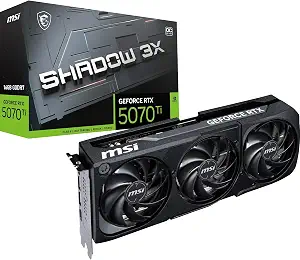
Compare the exact model name and variant wherever the offer appears. This listing identifies the MSI GeForce RTX 5070 Ti 16G Shadow 3X OC, with three fans and the specifications described above. Those identifiers give you a way to distinguish it from other graphics cards or listings with similar naming. Do not assume that an offer for a related model includes the same memory, clock, interface, outputs, resolution information or power requirement.
Black Friday pricing can draw attention away from product details, so check the complete listing before deciding whether an offer suits you. Compare the stated features and variant, then weigh them against your own build and display plans. No active promotion or saving is established here; the useful decision is whether the exact offer you find is for the product you want and fits your requirements. If a detail is missing or inconsistent, verify it rather than filling in the gap yourself.
Key specs
| Graphics memory | 16GB GDDR7 (28Gbps/256-bit) |
| GPU clock | Boost: 2482 MHz |
| Interface | PCIe 5 |
| Video outputs | DisplayPort, HDMI |
| Number of fans | 3 |
| Maximum display resolution | 4K UHD (3840×2160) |
| Minimum power supply | A power supply with min. 750 W |
Make your Black Friday choice
A careful Black Friday decision on this card comes down to matching its documented features to your plans: 16GB GDDR7 (28Gbps/256-bit), Boost: 2482 MHz, PCIe 5, DisplayPort and HDMI, a maximum display resolution of 4K UHD (3840×2160), three fans and a power supply with min. 750 W. Confirm the exact model and variant, then check the connection, displays and power requirement against your intended system. That gives you a grounded basis for judging an offer without assuming a discount, compatibility detail or performance result that the listing does not establish.